
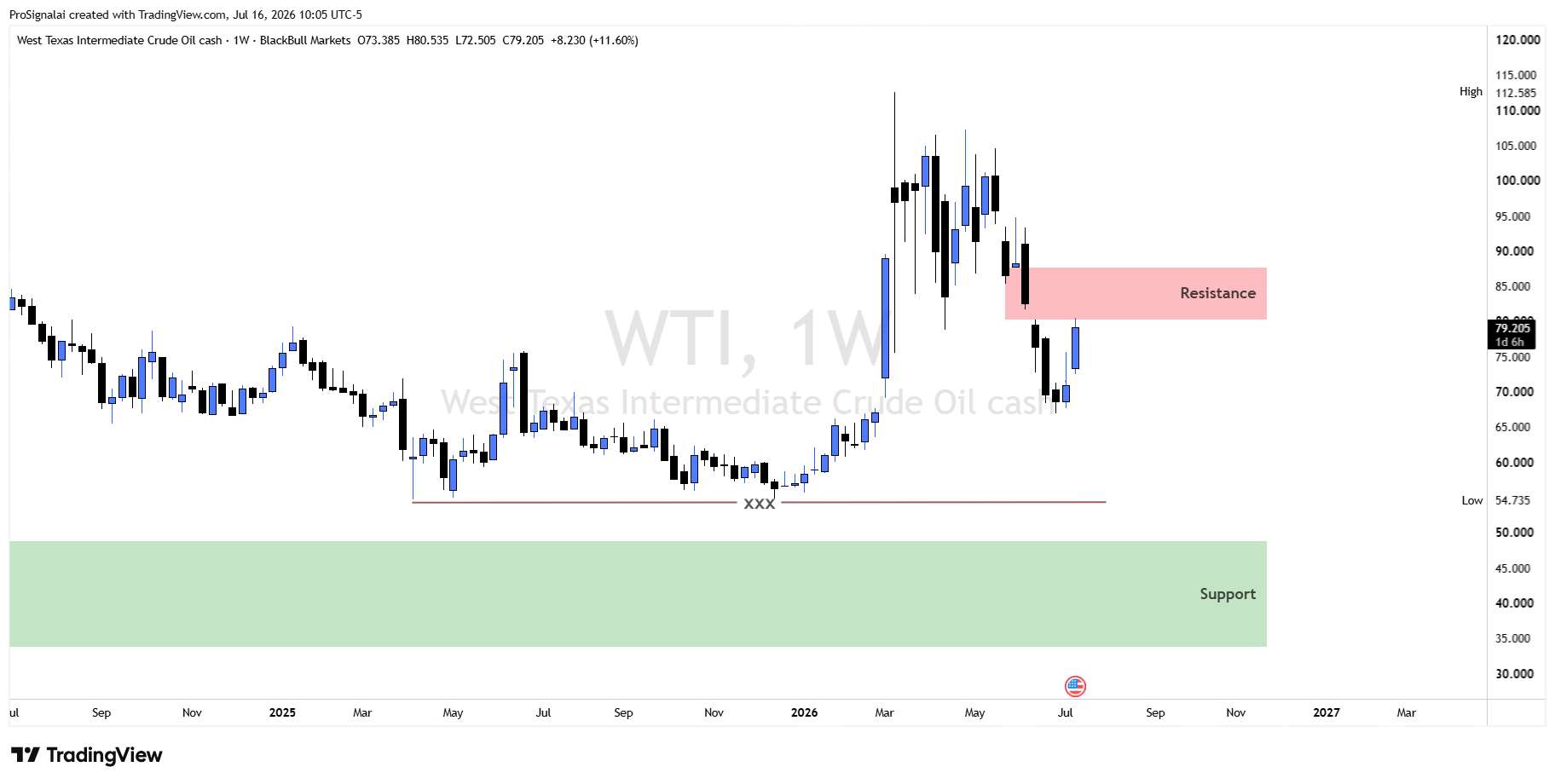
Despite the bullish backdrop, WTI is currently sitting at resistance and could pull back toward the $48–$33 range before a potential rebound.
WTI Crude Oil is trading slightly below the key 80.00 level as renewed geopolitical tensions in the Middle East continue to support oil prices and increase market uncertainty.
The United States Central Command (CENTCOM) is reportedly focusing its attacks on Iranian fuel infrastructure around the Strait of Hormuz, while the Islamic Revolutionary Guard Corps (IRGC) is targeting military facilities in Qatar and Kuwait. At the same time, both sides continue to disrupt shipping through the strategic waterway and restrict access to Iranian ports. Yesterday, International Monetary Fund (IMF) experts offered a cautious assessment of the hydrocarbon market, noting that even if hostilities ended immediately and traffic through the Strait of Hormuz resumed, restoring energy supplies would take at least three months. With the timing of a diplomatic resolution once again uncertain, expectations for a meaningful recovery in the sector before the end of the year remain limited.
Against this backdrop, oil prices have returned to their spring highs. However, despite the supportive geopolitical and fundamental factors, WTI is currently approaching a significant resistance area. This suggests that the market may be vulnerable to a technical correction in the near term. Traders are also reassessing expectations for the Federal Reserve's next policy moves, with the possibility of monetary easing being delayed until September or later in the year. A more dovish Fed outlook is further supported by the latest wholesale inflation data. In June, the Producer Price Index (PPI) declined from 0.6% to –0.3% MoM and from 6.0% to 5.5% YoY, significantly below the 6.2% consensus forecast.
Meanwhile, the United States continues to draw down its fuel reserves. As of July 10, crude inventories in US storage facilities stood at 316.504M barrels, the lowest level since 1983, despite production increasing by 1.0K barrels per day to 13.861M barrels per day. On Tuesday evening, the American Petroleum Institute (API) reported another inventory decline of 0.056M barrels, following a 0.399M-barrel drawdown the previous week. According to the US Energy Information Administration (EIA), inventories fell by a further 1.692M barrels on Wednesday, compared with a previous increase of 2.998M barrels.
Market activity is also accelerating. Data from the Chicago Mercantile Exchange (CME Group) showed futures volume reaching a summer high of 1.7M contracts on July 14, while options volume rose to 312.0K, well above last week's average of 160.0K. The same increase in speculative positioning is visible in the US Commodity Futures Trading Commission (CFTC) data, with net speculative contracts rising to 110.5K from 75.7K.
Nevertheless, from a technical perspective, WTI remains positioned near major resistance. If the current resistance zone holds, the instrument could enter a deeper corrective phase, with potential downside targets in the $48–$33 range. Only after reaching these lower levels could the market potentially form a stronger base and begin a new rebound.
Support and Resistance
On the weekly timeframe, WTI Crude Oil is trading near the upper boundary
Resistance levels: 81.00, 88.50
Support levels: 48.77, 33.94
Technical outlook: Despite strong geopolitical and fundamental support, WTI is approaching resistance and may face a deeper correction. A potential decline toward the $48–$33 area could create the conditions for a stronger rebound.
Disclaimer
Educational example only. Signals are not financial advice; trade at your own risk.